
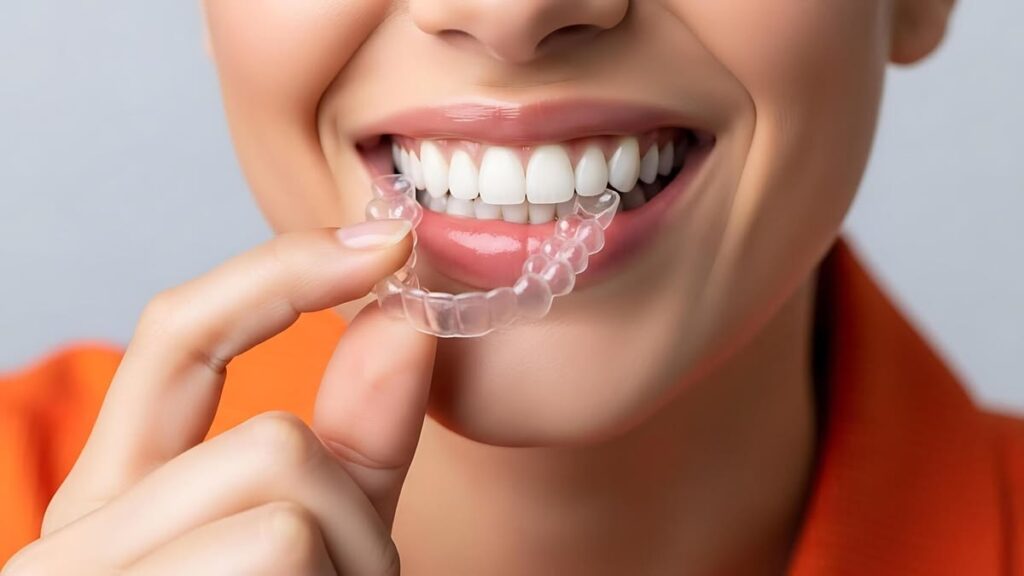
Crooked, crowded, or gapped teeth affect more than just appearance — they can also make chewing, cleaning, and even speaking a little harder than they should be. Teeth aligners have become one of the most popular ways to correct these issues without the visible metal wires of traditional braces.
Teeth aligners are clear, custom-made plastic trays that gradually shift teeth into proper alignment through a series of gentle, incremental adjustments. Each set is worn for one to two weeks before switching to the next in the series, with full treatment typically taking 6 to 18 months. Unlike traditional braces, aligners are removable, nearly invisible, and require no metal brackets or wires.
What Are Teeth Aligners?
Teeth aligners are orthodontic devices made from smooth, transparent medical-grade plastic. They are custom-fabricated for each patient using a digital scan or impression of the teeth, so every tray fits precisely over the natural tooth structure.
Instead of a single appliance worn for the entire treatment (as with braces), aligner treatment uses a series of trays, each one slightly different from the last. As teeth respond to the pressure of one tray, the patient moves to the next, and the cumulative effect over months is a straighter, better-aligned smile.
How Do Teeth Aligners Straighten Your Teeth?
Aligners work through controlled, gentle force applied at specific points on the teeth:
- Digital scanning – A 3D scan or impression maps the current position of every tooth.
- Treatment planning – A dentist designs a step-by-step movement plan, showing how teeth will shift from their starting position to the final result.
- Custom fabrication – A series of aligner trays is manufactured, each one calibrated to move teeth a fraction of a millimeter.
- Sequential wear – Patients wear each tray for 20–22 hours a day, switching to the next set every 1–2 weeks.
- Progress monitoring – Regular dental visits confirm teeth are tracking correctly with the plan.
Because each tray only asks the teeth to move a small amount, the process is generally more comfortable than the periodic tightening associated with metal braces.
Who Should Consider Teeth Aligners?
Aligners are suitable for a wide range of patients, particularly those with:
- Mild to moderate crowding or overlapping teeth
- Gaps or spacing between teeth
- Minor bite issues, such as slight overbite, underbite, or crossbite
- Teeth that have shifted after previous orthodontic treatment
- A preference for a discreet, removable option over fixed braces
Patients with more complex bite or jaw alignment issues may need a different orthodontic approach, which is why a clinical evaluation is the right starting point.
How Long Does Teeth Aligner Treatment Take?
Most treatment plans run between 6 and 18 months, depending on:
- The severity of misalignment
- How consistently the aligners are worn
- Whether attachments or additional dental work are needed
- The specific treatment goals set during planning
Mild cases may see results in as little as a few months, while more involved corrections take longer.
What Are the Benefits of Teeth Aligners?
- Nearly invisible – Clear trays are far less noticeable than metal brackets and wires.
- Removable – Aligners come out for eating, brushing, and flossing, so there are no food restrictions.
- Comfortable – No metal components mean less irritation to the cheeks, lips, and gums.
- Easier hygiene – Regular brushing and flossing stay simple throughout treatment.
- Predictable planning – Digital treatment mapping shows the expected progression before treatment even begins.
How Do Teeth Aligners Compare to Traditional Braces?
Factor | Aligners | Traditional Braces |
Visibility | Nearly invisible | Clearly visible metal |
Removability | Removable | Fixed in place |
Comfort | Smooth plastic, minimal irritation | Wires/brackets can irritate soft tissue |
Hygiene | Easy to clean around | Requires extra care |
Best for | Mild-to-moderate cases | Mild to complex cases |
How to Care for Teeth Aligners
- Wear aligners for the recommended 20–22 hours daily to stay on schedule.
- Rinse and brush aligners each time they are removed.
- Avoid eating or drinking anything besides water while wearing them to prevent staining.
- Store aligners in their case when not in use rather than loose in a bag or napkin.
- Attend scheduled dental check-ups so progress can be verified.
Ready to Start Your Smile Journey?
We understand that choosing the right orthodontic option can feel overwhelming, which is why our team takes time to walk every patient through their choices in detail. If you’re searching for reliable teeth aligners in Pune, book a consultation with our team to find out whether clear aligners are the right fit for your smile.
Frequently Asked Questions
- Are teeth aligners as effective as traditional braces?
For mild to moderate alignment issues, teeth aligners are generally as effective as traditional braces, with the added benefits of being removable and nearly invisible. For complex bite or jaw corrections, a dentist may recommend braces or a combination approach instead. - Do teeth aligners hurt?
Most patients experience mild pressure or tightness for a day or two after switching to a new tray, which is a sign the aligner is working. This sensation is typically much milder than the discomfort associated with tightening traditional braces. - Can I eat and drink normally with aligners?
Yes — because aligners are removable, they should be taken out before eating or drinking anything other than water. This means there are no food restrictions, unlike with fixed metal braces. - How often do I need to change my aligners?
Aligners are typically changed every 1 to 2 weeks, moving on to the next tray in the custom-designed series. The exact schedule depends on the individual treatment plan created by the dentist. - Will I need to wear a retainer after aligner treatment?
Yes, a retainer is typically provided after treatment to hold teeth in their new position and prevent gradual shifting back over time. Retainer wear is usually most intensive right after treatment and can be reduced over time as advised by the dentist.